Sponsors of the Caltech Space Challenge 2026

OKSI
Based in Los Angeles, OKSI is a premier provider of advanced electro-optical and infrared (EO/IR) sensor systems and AI-driven autonomous software. For over 30 years, they have been a key partner to the DoD, NASA, and major aerospace firms, specializing in the collection and interpretation of optical information in the most demanding environments. Their expertise spans from the depths of the ocean to the edge of the solar system, providing critical situational awareness for both defense and scientific exploration.
OKSI’s core strength lies in their ability to integrate machine learning with sophisticated hardware to solve complex navigation and targeting challenges. Their "OMNInav" and "OMNISCIENCE" platforms enable unmanned systems to navigate accurately in GPS-denied environments and perform autonomous target recognition. These technologies are vital for modern aerospace applications, including hypersonic vehicle tracking, plume diagnostics for rocket engines, and precision guidance for long-range strike missions.
In addition to defense, OKSI’s environmental and space exploration divisions help scientists characterize our world and others. Their hyperspectral imaging sensors provide high-resolution data for atmospheric monitoring and planetary science, helping to answer fundamental questions about the universe. OKSI’s sponsorship of this event reflects their commitment to pushing the boundaries of what is possible through the marriage of optics and artificial intelligence.
KECK Institute for Space Studies
The Keck Institute for Space Studies (KISS) develops new planetary, Earth, astrobiology and astrophysics space mission concepts and technology by bringing together a broad spectrum of scientists and engineers for sustained scientific and technical interaction. KISS is a think tank centered on the intellectual, instrumentation, and research strengths of the Caltech Campus and JPL — and augments those strengths by inviting external experts from academia, government, and industry to engage in its programs. The Institute also provides opportunities for graduate students and postdoctoral fellows to actively participate in cutting edge space mission research and learning. The Institute supports significant outreach to the public and the wider technical/scientific community via its lectures and online dissemination of study results.


DCUBED
Dcubed is a "NewSpace" industry leader headquartered in Germany, specializing in the development of high-performance release actuators and deployable structures. The company was founded on the principle of making space engineering "easy" by providing commercial off-the-shelf (COTS) hardware that is both affordable and highly reliable. Their portfolio includes the world’s smallest pin pullers and release nuts, which are critical for securing satellite components during launch and ensuring they deploy successfully once in orbit.
Beyond simple release mechanisms, Dcubed is at the forefront of orbital infrastructure with its innovative deployable solar arrays and booms. By utilizing patented shape-memory technology and proprietary "origami" structures, they enable small satellites to achieve maximum power and capability within highly constrained volumes. Their products are designed for rapid iteration and are field-resettable, allowing engineers to perform hundreds of ground tests with the same flight hardware—a significant advantage in reducing mission risk.
Jet Propulsion Laboratory
We are humanity’s leading center for exploring where humans cannot yet reach. Our spacecraft have flown to every planet and the Sun in a quest to understand our place in the universe, and to search for the possibility of life beyond Earth. Our missions honor the relentless pursuit of the explorer: Voyager, Curiosity, Cassini, Galileo.
We observe our home planet with missions to study our climate and assist in disaster recovery. We discover distant worlds with telescopes such as Hubble, for which JPL designed ingenious corrective optics. The giant antenna dishes of our Deep Space Network capture signals from nearly all spacecraft launched by the world into outer space.


Northrop Grumman
Honeybee Robotics is a world-renowned robotics firm and a subsidiary of Blue Origin, dedicated to building advanced systems for planetary exploration and spacecraft motion control. Since 1983, Honeybee has established a remarkable legacy by contributing critical hardware to nearly every major mission to Mars, including the specialized drills and sampling tools found on the Spirit, Opportunity, and Curiosity rovers. They are the industry standard for high-reliability mechanisms designed to survive the harshest environments in the solar system.
The company’s expertise extends across several sectors, including lunar infrastructure, asteroid mining, and satellite servicing. Honeybee develops everything from "meter-class" drills for extracting ice on the Moon and Mars to sophisticated solar array deployment mechanisms for orbiting spacecraft. Their work is essential for the future of "In-Situ Resource Utilization" (ISRU), which will allow future astronauts to live off the land by mining water and oxygen from celestial bodies.
Center for Autonomous Systems
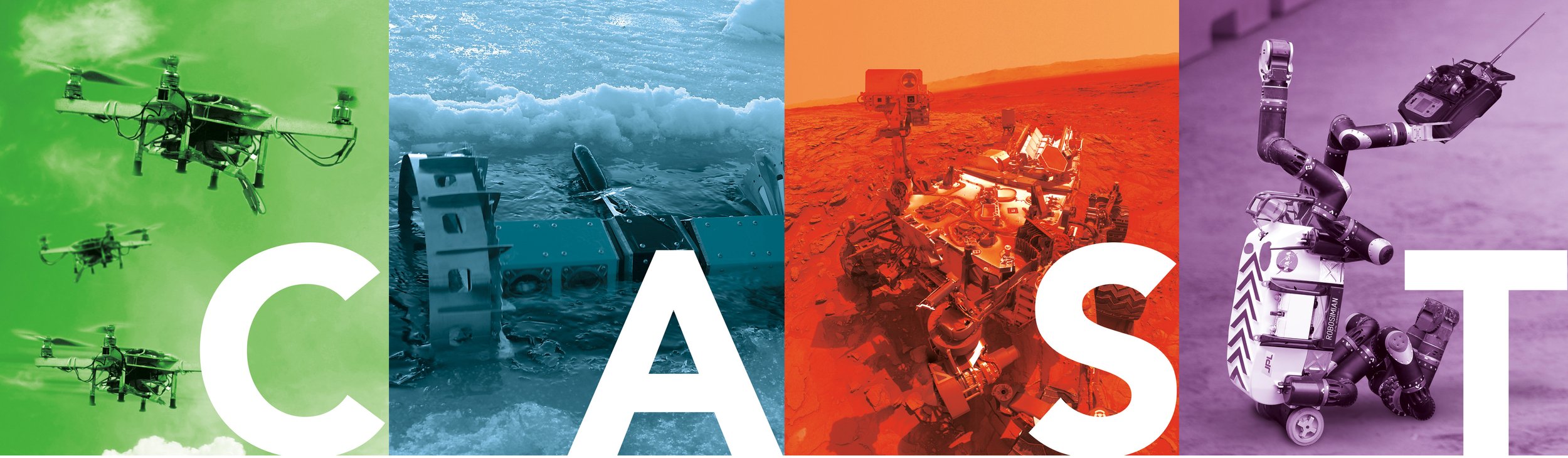
The Center for Autonomous Systems and Technologies (CAST) is a 10,000-square-foot facility where machines and researchers work together and learn from one another. At CAST, researchers from Caltech's Division of Engineering and Applied Science (EAS), Division of Geological and Planetary Sciences (GPS), and the Jet Propulsion Laboratory (JPL) collaborate to create the next generation of autonomous systems, advancing the fields of drone research, autonomous exploration, and bio-inspired systems.
PARSEC Rocketry team
Parsec is Caltech’s premier student-led rocketry organization, composed of passionate undergraduate and graduate students dedicated to pushing the limits of amateur high-altitude flight. The team operates like a professional aerospace startup, with specialized sub-teams focused on propulsion, avionics, structures, and software engineering. Their primary mission is to design, build, and launch complex bi-liquid-propellant rockets, providing members with invaluable hands-on experience that mirrors the challenges of the commercial space industry.
Make a donation
Support the Caltech Space Challenge with a private donation to help us give these students one of the most exciting and unique learning experiences in their education to date!
To learn more about the recognition for donors and to become a donor, please contact spacechallenge@caltech.edu.